Sperm Retrieval Procedures for Male Infertility: TESA, PESA and Micro-TESE Explained
When a couple is having difficulty conceiving, a semen analysis is often one of the first tests used to understand the male partner’s fertility. Sometimes, the report shows no sperm in the semen. This condition is called azoospermia. However, a zero sperm count does not always mean that sperm is not being produced.
In some men, sperm is produced but cannot reach the semen because of a blockage. In others, sperm production inside the testicles is very limited. Depending on the cause, doctors may consider sperm retrieval procedures to collect sperm directly from the epididymis or testicular tissue. The retrieved sperm may then be used for intracytoplasmic sperm injection (ICSI).
At Archish Fertility and IVF Clinic in Bangaluru, understanding the cause of azoospermia helps the fertility team determine whether PESA, TESA, Micro-TESE, or another approach is appropriate for sperm retrieval.
When is Surgical Sperm Retrieval Considered?
Surgical sperm retrieval is considered when sperm cannot be obtained through ejaculation, but there is a possibility of finding usable sperm in the reproductive tract or testicles. The first step is to identify why sperm is absent from the semen.
Fertility doctors generally look at whether the azoospermia is:
- Obstructive Azoospermia (OA), where sperm production may be preserved, but a blockage prevents sperm from reaching the semen.
- Non-obstructive Azoospermia (NOA), where sperm production inside the testicles is severely reduced or occurs only in small areas.
A fertility evaluation may include repeat semen analysis, physical examination, hormonal testing, and genetic tests when indicated. These findings help the doctor understand where sperm is most likely to be found and whether sperm retrieval for azoospermia may be appropriate.
For men with obstructive azoospermia, sperm may be retrieved from either the epididymis or testicle. In non-obstructive azoospermia, Micro-TESE is generally the preferred surgical retrieval approach when ICSI is planned.
What is PESA, TESA and Micro-TESE?
PESA, TESA, and Micro-TESE are three sperm retrieval techniques. These techniques differ mainly in where sperm is collected from and the type of azoospermia they are commonly used to address.
The choice is based on the underlying cause and the likelihood of finding usable sperm.
| Procedure | Where sperm is retrieved from | Commonly considered for |
|---|---|---|
| PESA | Epididymis | Mainly obstructive azoospermia |
| TESA | Testicular tissue | Selected cases of obstructive or non-obstructive azoospermia |
| Micro-TESE | Testicular tissue using microscopic examination | Mainly non-obstructive azoospermia |
Note: All three are forms of sperm retrieval for male infertility, but they are not interchangeable.
What is PESA and When is it Used?
PESA, or percutaneous epididymal sperm aspiration, is a sperm retrieval procedure that collects sperm directly from the epididymis.
It is mainly considered when sperm production is intact but a blockage prevents sperm from reaching the semen.
How is PESA Performed?
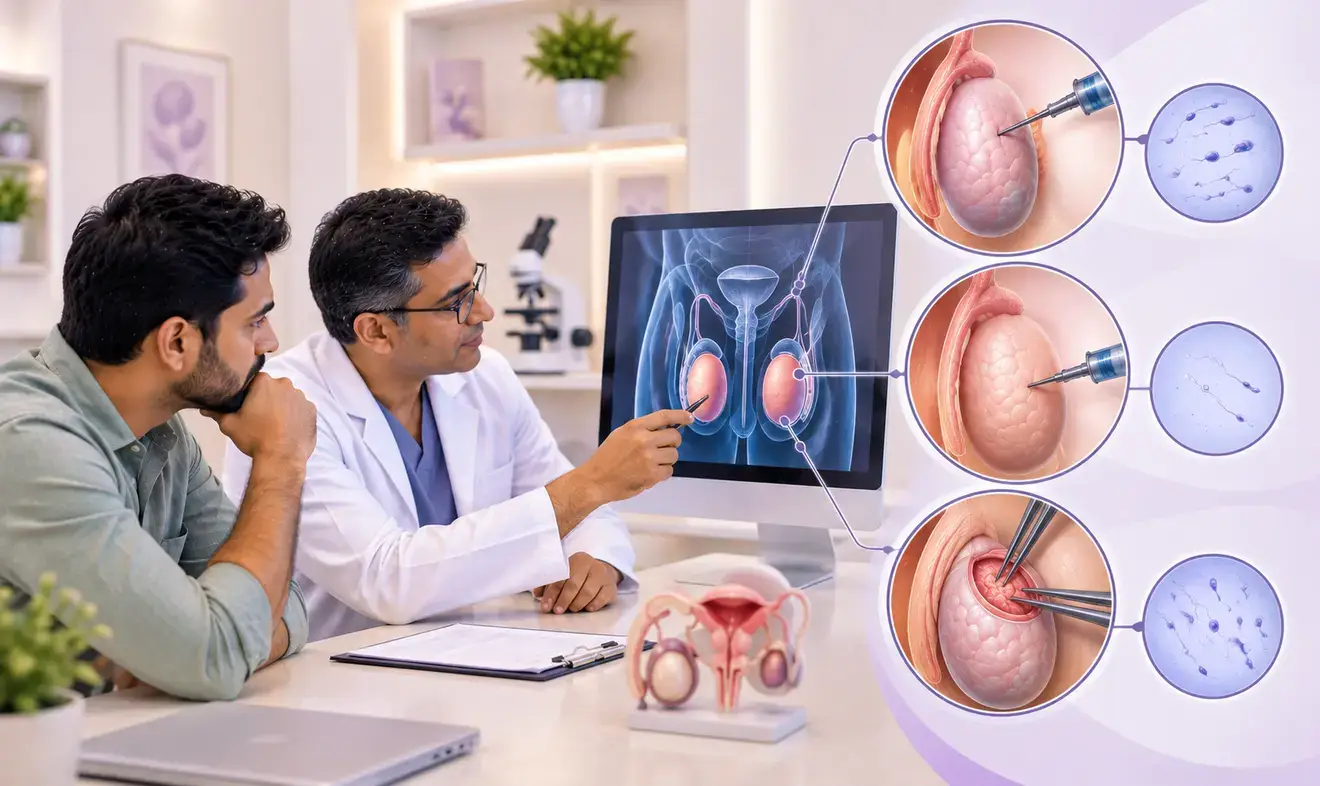
PESA is performed by inserting a fine needle through the scrotal skin into the epididymis. The doctor gently aspirates fluid that may contain sperm. The collected sample is then immediately examined by the embryology laboratory to identify sperm and assess whether usable sperm is present.
The procedure is generally performed with appropriate anesthesia or local anesthesia, depending on the clinical setting and the patient’s needs.
When Is PESA Recommended for Azoospermia?
PESA is most commonly recommended for obstructive azoospermia. In this condition, the testicles may continue to produce sperm, but a blockage in the reproductive tract prevents sperm from appearing in the semen.
It may be considered in situations such as:
- Previous vasectomy, when sperm production remains intact
- Congenital absence or blockage of parts of the sperm-carrying pathway
- Certain epididymal blockages
- Other cases where the doctor expects sperm to be available in the epididymis
A fertility specialist first evaluates the man’s semen analysis, medical history, physical findings, and other relevant tests before deciding whether PESA can be performed.
How is PESA-Retrieved Sperm Used in ICSI?
If viable sperm is identified in the PESA sample, it can be used for intracytoplasmic sperm injection (ICSI). In ICSI, an embryologist injects a single sperm directly into a mature egg to facilitate fertilization.
This allows men with obstructive azoospermia to potentially use their own sperm for assisted reproduction even when sperm cannot be obtained through ejaculation.
The retrieved sperm may be used during the same treatment cycle or cryopreserved for future use, depending on the fertility treatment plan.
What if PESA Does Not Retrieve Enough Sperm?
PESA does not guarantee that an adequate number of usable sperm will be obtained. If the sample does not contain sufficient sperm, the fertility team may consider another retrieval technique based on the underlying diagnosis.
What is TESA and When is it Used?
TESA, or testicular sperm aspiration, is a sperm retrieval procedure that collects sperm directly from the testicular tissue.
It may be considered when sperm cannot be obtained through ejaculation and testicular sperm retrieval is appropriate based on the underlying cause of infertility.
How is TESA Performed?
TESA is performed by inserting a fine needle through the scrotal skin into the testicle to aspirate a small sample of testicular tissue. The sample is examined by the embryology laboratory to determine whether sperm is present and whether it is suitable for use in assisted reproduction.
The procedure is generally performed under local anesthesia or other appropriate anesthesia, depending on the clinical setting.
Because TESA retrieves sperm directly from the testicle, it can be considered when sperm is not available in the epididymis or when the fertility team determines that testicular sperm retrieval is more appropriate.
When is TESA Recommended for Azoospermia?
TESA may be considered in selected cases of obstructive azoospermia, where sperm production is preserved, but a blockage prevents sperm from reaching the semen. It can also have a role in certain other situations where testicular sperm retrieval is indicated.
It may be considered in situations such as:
- Obstructive azoospermia when testicular sperm retrieval is preferred
- Previous vasectomy or reproductive tract obstruction
- Selected cases where sperm cannot be adequately retrieved from the epididymis
- Certain cases requiring testicular sperm for assisted reproduction
The fertility specialist considers the cause of azoospermia, previous procedures, testicular function, and other fertility findings before recommending TESA.
How is TESA-Retrieved Sperm Used in ICSI?
If viable sperm is found in the TESA sample, it can be used for intracytoplasmic sperm injection (ICSI). During ICSI, an embryologist injects a single sperm directly into a mature egg to facilitate fertilization.
This can allow men who cannot provide usable sperm through ejaculation to use their own sperm in an assisted reproduction cycle, when retrieval is successful and ICSI is appropriate.
The retrieved sperm may be used in the same treatment cycle or preserved for future use, depending on the treatment plan.
What if TESA Does Not Retrieve Enough Sperm?
TESA may not always yield sufficient usable sperm. If the procedure does not provide an adequate sample, the fertility team may consider another retrieval approach based on the underlying cause and the likelihood of finding sperm.
For men with non-obstructive azoospermia, where sperm production is significantly impaired, a different approach such as Micro-TESE may be considered.
What is Micro-TESE and When is it Used?
Micro-TESE, or microsurgical testicular sperm extraction, is a surgical sperm retrieval procedure used to search for sperm directly within the testicular tissue.
It is mainly considered for men with non-obstructive azoospermia, where the testicles produce very little sperm or sperm production occurs only in small areas.
How is Micro-TESE Performed?
Micro-TESE is performed under anesthesia. The surgeon makes a small incision in the testicle and examines the testicular tissue under an operating microscope. The magnification helps identify areas of tissue that may contain sperm-producing tubules.
Small samples are carefully collected and sent to the embryology laboratory. The laboratory examines the tissue under a microscope to look for viable sperm.
Because sperm production can be uneven in non-obstructive azoospermia, examining the testicular tissue under magnification can help the surgeon target areas that are more likely to contain sperm while limiting unnecessary tissue removal.
When is Micro-TESE Recommended for Azoospermia?
Micro-TESE is primarily considered for men with non-obstructive azoospermia, particularly when sperm is not found in the semen and other evaluations suggest severely impaired sperm production.
It may be considered in situations such as:
- Non-obstructive azoospermia
- Very limited or focal sperm production within the testicles
- Cases where previous evaluation suggests that sperm may still be present despite a zero sperm count
- Men undergoing surgical sperm retrieval as part of an ICSI treatment plan
The decision depends on the underlying cause of azoospermia, hormonal and genetic evaluation, testicular findings, and the overall fertility plan. Current AUA/ASRM guidance recommends Micro-TESE for sperm retrieval in men with non-obstructive azoospermia when surgical retrieval is indicated.
How Is Micro-TESE-Retrieved Sperm Used in ICSI?
If viable sperm is identified in the tissue collected during Micro-TESE, it can be used for intracytoplasmic sperm injection (ICSI). An embryologist selects an appropriate sperm and injects it directly into a mature egg to facilitate fertilization.
This provides an option for men with severe sperm production problems who may not have usable sperm in their ejaculate. However, Micro-TESE cannot guarantee that sperm will be found.
What If Micro-TESE Does Not Retrieve Sperm?
In some men with non-obstructive azoospermia, sperm may not be found even after a detailed microscopic search of the testicular tissue. The outcome depends largely on the underlying cause and extent of sperm production.
If no usable sperm is retrieved, the fertility specialist discusses the available next steps with the couple based on their diagnosis, previous treatment, and reproductive goals.
In Which Situations are Sperm Reterival Procudures Considered?
If you are wondering whether PESA, TESE or Micro-TESE would be performed for male infertility, these common clinical situations offer a quick overview:
| Clinical situation | Sperm retrieval procedure that may be considered |
|---|---|
| Obstructive azoospermia with preserved sperm production | PESA |
| Sperm is expected to be available in the epididymis | PESA |
| Testicular sperm is required in a selected case | TESA |
| Epididymal retrieval is unsuccessful or not appropriate | TESA |
| Non-obstructive azoospermia with severely impaired sperm production | Micro-TESE |
| Sperm production may be limited to small areas within the testicles | Micro-TESE |
What Happens After Sperm Retrieval?
Once sperm is retrieved, the sample is sent to the embryology laboratory, where it is examined to identify usable sperm. The next steps depend on the number and quality of sperm obtained and the couple’s fertility treatment plan.
Sperm is Examined in the Laboratory
The embryology team examines the retrieved sample under a microscope to identify sperm and assess whether viable sperm is available for treatment. In some cases, only a small number of sperm may be found, particularly with non-obstructive azoospermia.
Retrieved Sperm May Be Used for ICSI
When suitable sperm is available, it can be used for intracytoplasmic sperm injection (ICSI). The embryologist selects an appropriate sperm and injects it directly into a mature egg to facilitate fertilization.
This allows retrieved sperm to be used even when sperm cannot be obtained through ejaculation.
Sperm May Be Preserved for Future Use
If enough suitable sperm is retrieved, the laboratory may cryopreserve some of the sample for future treatment. This can provide an additional option for a later ICSI cycle without requiring another retrieval procedure in every case.
What if No Usable Sperm is Found?
Sperm retrieval does not guarantee that usable sperm will be obtained. If no sperm or insufficient viable sperm is found, the fertility specialist will discuss the next available options based on the underlying cause of azoospermia and the couple’s treatment plan.
Conclusion
Azoospermia does not always mean that biological fatherhood is impossible. When sperm cannot be found in the semen, sperm retrieval procedures may offer a way to obtain sperm directly from the epididymis or testicles for use in assisted reproduction.
PESA, TESA, and Micro-TESE are used in different clinical situations. The appropriate approach depends on the underlying cause of azoospermia and where viable sperm is most likely to be found.
At Archish Fertility and IVF Clinic in Bangaluru, a detailed evaluation can help identify the cause of male infertility and determine whether sperm retrieval and ICSI may be suitable options. With the right diagnosis and treatment plan, couples can better understand their available path toward parenthood.
FAQs
No. The outcome depends on the cause of azoospermia, sperm production, and the retrieval technique used. Some men may not have usable sperm available for retrieval.
As with any medical procedure, sperm retrieval can carry risks such as pain, bleeding, infection, or temporary swelling. Your doctor will explain the potential risks associated with the recommended technique.
Recovery varies by procedure. Mild soreness or discomfort may occur for a few days, while recovery from a surgical procedure may take longer. Your fertility team will provide specific aftercare instructions.
Yes. Sperm retrieval can be planned as part of an IVF-ICSI treatment cycle. The timing depends on the type of retrieval, the availability of sperm, and the treatment plan.