IVF Age Limit in India: Rules, Eligibility and Success Rates by Age
IVF can offer a path to parenthood when pregnancy does not happen naturally. It can also be an option for people who choose to start their families later in life. But one factor can significantly influence both eligibility and treatment outcomes: age.
The IVF age limit in India is generally below 50 years for women and below 55 years for men under India’s ART framework. However, being within the legal age limit does not necessarily mean that IVF will have a high chance of success, particularly when using your own eggs.
Egg quality, ovarian reserve, sperm health, embryo quality, and overall health can all affect the outcome. Knowing the age limit for IVF in India is therefore only the first step. You also need to understand how age can affect your chances of success.
In this blog, we will discuss the age limit for IVF in India, how age affects IVF success rates, and what treatment options may be available at different stages of life.
Is There an Age Limit for IVF in India?
Yes. IVF and other assisted reproductive technologies are regulated under India’s Assisted Reproductive Technology (ART) law.
The Assisted Reproductive Technology (Regulation) Act, 2021 provides the legal framework for IVF and other ART services in India. It regulates ART clinics and banks, gamete donation, and assisted reproductive procedures.
Under the Act, ART services can be provided to a woman below 50 years and a man below 55 years, subject to the applicable requirements. Registered fertility centres must follow the ART rules in India, including requirements related to informed consent, donor screening, records, and treatment standards.
For patients, the key distinction is between legal eligibility and medical suitability. Being within the legal age limit for IVF does not necessarily mean that treatment will have a high chance of success. Age, ovarian reserve, egg and sperm quality, overall health, and other fertility factors all play a role in determining your chances.
| You can read the Assisted Reproductive Technology (Regulation) Act, 2021 to understand the complete legal framework. |
What are the IVF Age Rules in India?
The ART Regulation Act, 2021 has laid down separate IVF age rules for both Men and Women in India. These are:
For women
- ART services are generally available below 50 years.
- Doctors may assess ovarian reserve before IVF.
- Medical health and the ability to carry a pregnancy are also important.
- Own-egg IVF may be considered when egg reserve and quality are suitable.
- Donor eggs may be discussed when own-egg IVF has a low chance of success.
For men
- ART services are generally available below 55 years.
- Sperm quality can change with age.
- A semen analysis can help identify male-factor infertility.
- Additional tests may be advised when needed.
What is the Age Limit for IVF Egg Donors in India?
ART regulations also cover egg donation. An oocyte donor must generally be 23 to 35 years old and meet the required medical and screening criteria.
This means that in donor-egg IVF, the age of the eggs is based on the donor’s age, not the age of the woman receiving them.
What is the Best Age for IVF?
There is no single best age for IVF. However, younger age generally gives better results when using your own eggs.
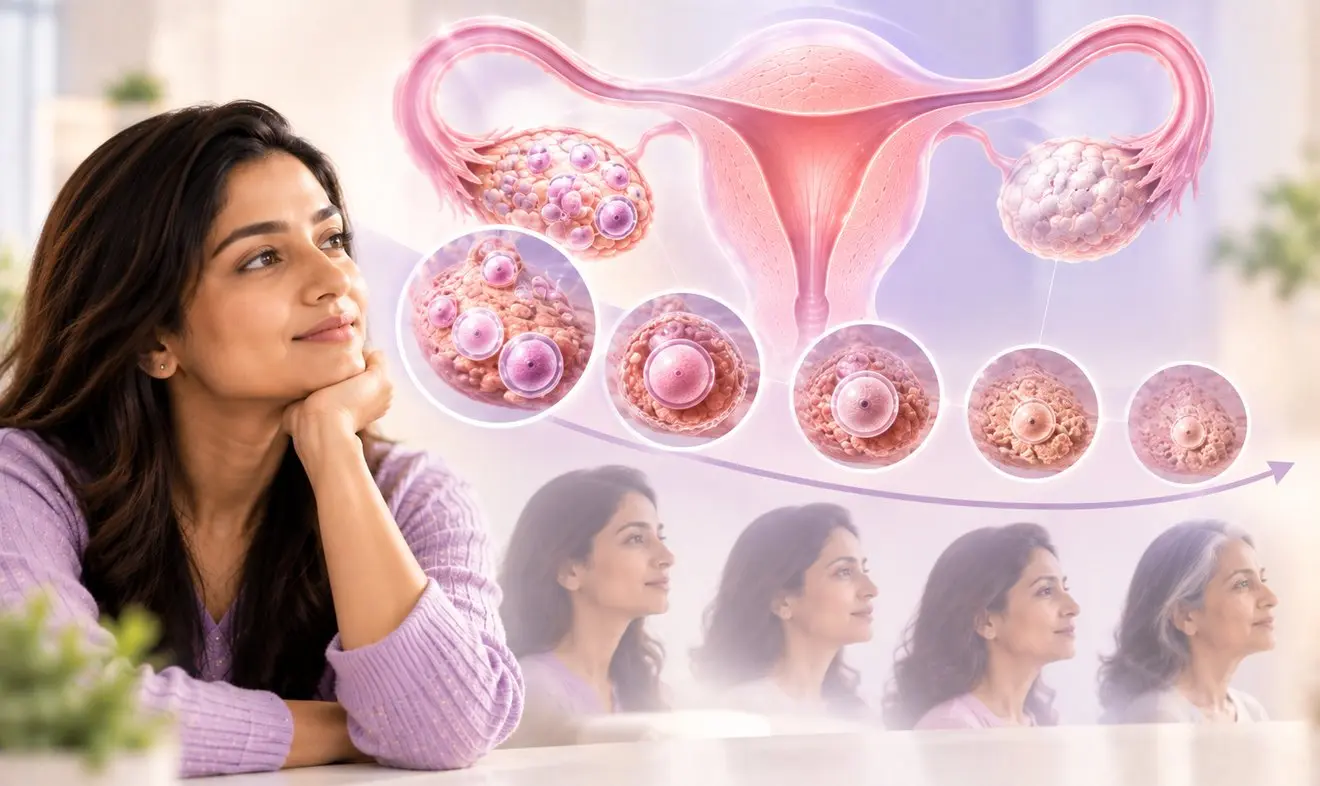
Fertility starts declining with age, with the decline becoming more noticeable after 35 and often more significant after 40.
The reason is not only the number of eggs available. Egg quality is also closely linked to age. As women get older, the chance of chromosomal abnormalities in eggs increases. This can affect embryo development, implantation, and the risk of miscarriage.
As a result, someone in their early 30s and someone in their early 40s may have very different IVF outcomes, even when both are otherwise healthy.
IVF Success Rate by Age: How Does Age Affect Your Chances?
Age is one of the factors that can influence IVF outcomes, particularly when using your own eggs. However, IVF success rates can vary from person to person. Clinic protocols, egg source, ovarian reserve, sperm quality, embryo quality, and the definition of success can all affect reported figures.
The following table explains how different ages affect the IVF process with own eggs:
| Age | General outlook with own eggs |
|---|---|
| Below 35 | Generally the most favourable |
| 35 to 37 | Chances may begin to decline |
| 38 to 40 | Age becomes a more significant factor |
| 41 to 42 | Success with own eggs is generally lower |
| 43 to 44 | Chances may become considerably lower |
| 45 and above | Own-egg IVF has a very low chance of success |
Please note: These are broad trends and should not be treated as individual predictions. It is also important to understand that pregnancy rate and live birth rate are different measures.
When comparing IVF success rates between clinics, ask what the reported rate represents and whether it is calculated per cycle, egg retrieval, or embryo transfer.
Can You Have IVF After 50?
For women, ART services are generally not available after 50 under India’s current framework.
The law sets the upper age for a woman receiving ART services at below 50 years. Reaching this statutory age limit can therefore affect legal eligibility for treatment. Age also needs to be considered from a medical perspective. Pregnancy at an older age can carry higher risks, including hypertension, diabetes, and miscarriage.
If you are approaching the legal age limit, discussing your options with a fertility specialist early can help you understand what may be possible within the available treatment window.
Can You Have IVF After 45?
IVF after 45 may be legally possible if you are still within the statutory age limit. However, own-egg IVF becomes more challenging at this stage.
The main concern is usually egg quality. As age increases, several changes can affect IVF outcomes:
- Egg quality can decline.
- Ovarian reserve may decrease.
- Chromosomal abnormalities become more common.
- Fewer embryos may develop normally.
- The risk of miscarriage can increase.
For some women, a doctor may discuss donor egg IVF when the chances of success with their own eggs are very low.
Does IVF Success Depend Only on Age?
No. Age is important, but it is only one part of the fertility picture.
Before recommending a treatment approach, your fertility specialist may assess several factors that can affect your chances of IVF success.
- Ovarian Reserve: AMH and antral follicle count provide information about egg quantity.
- Egg Quality: Age is one of the strongest factors affecting egg quality.
- Sperm Quality: Sperm count, movement, and morphology can affect fertilisation.
- Embryo Quality: Embryo development and genetic health can influence implantation.
- Uterine Health: Fibroids, polyps, and other conditions may affect implantation.
- Overall Health: Conditions such as diabetes and high blood pressure may need to be managed.
- Previous IVF History: Your response to earlier treatment can help guide future cycles.
| So, instead of asking, “What is the IVF success rate at my age?”, it may be more useful to ask, “What are my realistic chances based on my complete fertility profile?” |
Own-egg vs Donor-egg IVF: How Age Affects Your Treatment Options
One of the biggest differences between own-egg and donor-egg IVF is the biological age of the egg.
With own-egg IVF, egg quality is affected by the patient’s reproductive age. With donor-egg IVF, the eggs come from an eligible donor who meets the prescribed age and screening requirements.
| Factor | Own-egg IVF | Donor-egg IVF |
|---|---|---|
| Egg source | Patient’s own eggs | Eggs from an eligible donor |
| Egg age | Based on the patient’s reproductive age | Based on the donor’s age |
| Egg quality | May decline with increasing age | Generally comes from a younger donor |
| Ovarian reserve | Assessed to understand the available egg supply | Assessed in the donor |
| Genetic connection | The child has a genetic connection to the egg provider | The child does not have a genetic connection to the recipient through the egg |
| When it may be considered | May be suitable when egg reserve and quality are adequate | May be considered when own-egg IVF has a low chance of success |
| Recipient’s health | Important for carrying the pregnancy | Still important for carrying the pregnancy |
Donor eggs can help overcome age-related decline in egg quality and may be considered when the chances of success with own eggs are low.
However, they do not eliminate the health considerations associated with pregnancy at an older age. The recipient’s overall health and ability to safely carry a pregnancy still need to be assessed.
What Should You Check Before Starting IVF After 40?
If you are considering IVF after 40, age should not be the only factor guiding your decision. A fertility assessment can help you understand whether own-egg IVF is realistic and whether other options should be considered.
Ask your fertility specialist:
- What is my ovarian reserve?
- Are my own eggs a realistic option?
- Should I consider donor eggs?
- Is my uterus healthy for embryo transfer?
- Do I have any health concerns that need attention?
- What is my realistic chance of success?
- How much time do I have within the legal treatment window?
Getting these answers early can help you understand your options and make a more informed treatment decision.
Conclusion
Age can shape your fertility journey, but it does not tell the whole story. The more important question is not simply How old am I for IVF?, but What does my fertility profile tell me about my options?
If you are wondering whether IVF is medically suitable for you, what your chances may look like at your current age, or whether you should consider alternatives such as donor eggs, the right guidance can help you make that decision with greater clarity.
Don’t wait any further. Connect with our expert embryologists at Archish Fertility & IVF Clinic for expert consultation based on your fertility profile.
FAQs
Yes. Male age can also influence fertility and sperm quality, which may affect fertilisation, embryo development, and overall IVF outcomes. A semen analysis and other tests may be recommended based on the couple's fertility history.
Natural pregnancy is still possible after 40, but fertility generally declines with age. If you have been trying to conceive without success, a fertility evaluation can help identify whether IVF or another treatment may be appropriate.
The risk of miscarriage can increase with age, particularly when using your own eggs. This is partly linked to the higher likelihood of chromosomal abnormalities in eggs as age increases.
Pregnancy after 40 may carry a higher risk of certain complications, including high blood pressure and diabetes. Your overall health and medical history should be assessed before treatment and monitored throughout pregnancy.
No fixed number of IVF cycles is appropriate for everyone. Your age, ovarian reserve, response to treatment, embryo development, and previous IVF outcomes can help your fertility specialist determine whether another cycle is advisable.
Menopause means the ovaries are no longer releasing eggs regularly, so IVF using your own eggs is generally not an option after menopause. Depending on your health and circumstances, donor eggs may be discussed with a fertility specialist.