How Long Does the IVF Process Take from Start to Pregnancy?
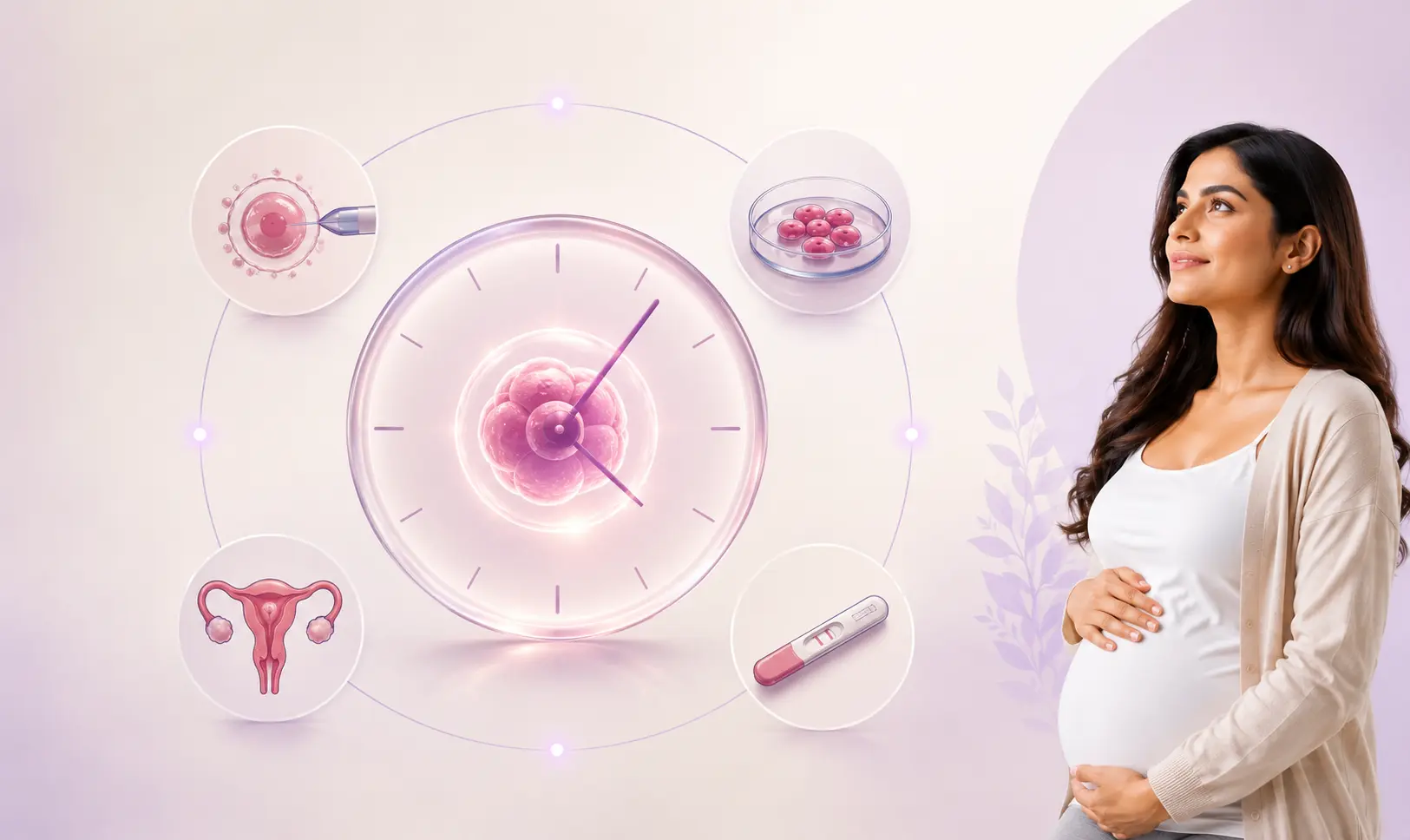
IVF Process Timeline at a Glance
The exact time from IVF to pregnancy depends on your treatment protocol, response to medications, embryo development, and transfer plan.However, a typical IVF treatment timeline can look like this:| IVF Stage | Approximate Time |
|---|---|
| Consultation and initial tests | Varies |
| Ovarian stimulation | Around 10 to 14 days |
| Egg retrieval | 1 day |
| Fertilisation | About 1 day |
| Embryo development | Around 5 to 6 days |
| Embryo freezing or genetic testing | Depends on the treatment |
| Embryo transfer | 1 day |
| Pregnancy test | Around 2 weeks after transfer |
| Fresh cycle, from start to pregnancy test | 4 to 6 weeks |
| Cycle with PGT-A or frozen transfer | 8 to 12 weeks |
Stage 1: Consultation and Fertility Tests
The IVF treatment timeline begins with a fertility consultation. Your doctor reviews your medical history, menstrual cycle, previous fertility treatments, and any known fertility concerns. This helps determine which tests you need before starting treatment.Depending on the above details, the initial evaluation may include:- Blood tests to assess ovarian reserve and hormone levels, such as AMH, FSH, LH, TSH, and prolactin
- Transvaginal ultrasound to assess the ovaries and count antral follicles
- Semen analysis to check sperm count, movement, and other parameters
- HSG or saline sonogram, when needed, to assess the uterus and fallopian tubes
- Infectious disease screening for both partners, as recommended
Stage 2: Ovarian Stimulation
Ovarian stimulation is the stage where IVF medications help the ovaries develop multiple follicles instead of the single dominant follicle that typically develops during a natural cycle.Treatment usually starts around day 2 or 3 of the menstrual cycle and continues for about 8 to 14 days. During this time, your doctor monitors follicle growth through ultrasound scans and blood tests and adjusts the medication when needed.Once the follicles are ready, you receive a trigger injection to help the eggs complete their final stage of maturation. Egg retrieval is usually scheduled about 34 to 36 hours after the trigger.Stage 3: Egg Retrieval
Egg retrieval is a short procedure used to collect mature eggs from the ovaries. It is performed under sedation, with a thin needle guided by ultrasound to gently collect fluid from the mature follicles.It is a 1-day procedure and usually takes around 15 to 30 minutes. The collected fluid is immediately sent to the embryology lab, where the eggs are identified and assessed for fertilisation.Most patients can go home within a few hours after the procedure.Stage 4: Fertilisation and Embryo Development
On the day of egg retrieval, the eggs are combined with sperm in the laboratory. Depending on the treatment plan, this may involve conventional IVF or ICSI, where a single sperm is injected directly into an egg.The embryology team checks for fertilisation the following day. The resulting embryos are then cultured and monitored as they develop.By around Day 5 or 6, some embryos may reach the blastocyst stage. At this point, suitable embryos may be considered for transfer, freezing, or genetic testing, depending on the treatment plan.Stage 5: Embryo Freezing and Genetic Testing
Not every patient needs genetic testing. When recommended, preimplantation genetic testing for aneuploidy (PGT-A) checks an embryo for an abnormal number of chromosomes before it is considered for transfer. It can help the fertility team identify embryos that are more likely to have the expected number of chromosomes.PGT-A is performed once an embryo reaches the blastocyst stage, usually around Day 5 or 6. A small sample of cells is taken from the embryo and sent to a genetics laboratory for testing. The embryo is then frozen using vitrification, a rapid freezing method, while the results are processed. Results may take around 1 to 2 weeks, depending on the laboratory.Embryos may also be frozen without genetic testing. In such cases, the frozen embryo can be used for a frozen embryo transfer in a later cycle.Stage 6: Embryo Transfer
Once the embryo is ready, the next step is embryo transfer, where the selected embryo is placed inside the uterus. The timing depends on whether you have a fresh or frozen embryo transfer.| Fresh Embryo Transfer | Frozen Embryo Transfer | |
|---|---|---|
| Timing | 3 to 5 days after retrieval, in the same cycle | In a separate cycle, usually after 2 to 4 weeks of uterine lining preparation |
| Best suited for | Good response to stimulation, no OHSS risk, and no genetic testing planned | Genetic testing, OHSS risk, or a uterine lining that needs more preparation |
| Added time | None | Usually 4 to 8 additional weeks |
Stage 7: The Two-Week Wait and Pregnancy Test
After embryo transfer comes the waiting period before pregnancy can be confirmed. Your clinic will schedule a beta hCG blood test, usually 9 to 14 days after transfer, depending on the stage of the embryo transferred. A Day 5 transfer may be tested around Day 9 to 11, while a Day 3 transfer may require testing closer to Day 12 to 14.So, how long after embryo transfer can you take a pregnancy test? It is best to follow the testing date given by your fertility team rather than testing early.During this period, the embryo may attach to the uterine lining. Implantation can occur within a few days after embryo transfer, after which the body begins producing hCG.However, it takes time for hCG levels to become detectable.This is why testing too early can give a false negative. Medication used for the trigger shot can also remain in the body and sometimes cause a false positive. A clinic-scheduled beta hCG blood test provides a more reliable confirmation of pregnancy.What Happens After a Positive IVF Pregnancy Test?
A positive pregnancy test after IVF confirms that implantation has occurred, but the next few weeks are still important for confirming how the pregnancy is progressing.Your fertility team may recommend a follow-up beta hCG blood test to assess the pregnancy hormone level. You will also usually continue any prescribed progesterone or other medications as advised by your doctor.An early transvaginal ultrasound is typically scheduled around 6 to 7 weeks of pregnancy. It helps confirm that the pregnancy is developing in the uterus and allows the doctor to check for early development and cardiac activity.Once the early pregnancy is confirmed and progressing well, your doctor will guide you on the next stage of pregnancy care.What Happens After a Failed IVF Cycle or Embryo Transfer?
A negative pregnancy test does not necessarily mean that the next IVF attempt will have the same outcome. The next step is usually to review the treatment cycle and understand what happened.Your fertility team may look at:- Your response to ovarian stimulation
- The number and maturity of eggs retrieved
- Fertilization results
- Embryo development and quality
- The uterine lining
- How the embryo transfer went
When Can You Start IVF Again?
There is no fixed waiting period that applies to everyone after an unsuccessful IVF cycle. Your doctor will consider your recovery, treatment response, and whether you have frozen embryos available before planning the next step.If you have frozen embryos, you may be able to proceed with a frozen embryo transfer once your doctor confirms that your body is ready and the uterine lining is suitable. If you need another full IVF cycle, your fertility team may first make changes to the treatment plan based on your previous response.Taking time to review the previous cycle can help your doctor decide whether you can start again in the next cycle or whether you need more time or preparation.What Can Delay the IVF Process?
The IVF process timeline can vary from one patient to another. Several factors may add time between treatment stages or require a cycle to be postponed. Thus, a timeline should be viewed as an estimate.Common reasons include:- Additional tests or treatment: Some patients need further evaluation or treatment before starting IVF.
- Ovarian response: The dose or duration of IVF medications may need adjustment if the ovaries respond differently than expected.
- Embryo development: Not every retrieved egg develops into an embryo suitable for transfer.
- Genetic testing: PGT-A requires embryos to be frozen while the test results are processed, leading to a later transfer.
- Uterine lining: A transfer may be postponed if the uterine lining is not ready.
- Risk of complications: Your doctor may recommend freezing the embryos and delaying transfer if there is a concern such as ovarian hyperstimulation syndrome.
- Need for another IVF cycle: If the first cycle does not produce a suitable embryo for transfer, another cycle may be needed.
Conclusion
IVF is a process with several checkpoints, and not every patient follows the exact same path. What matters is knowing what each stage involves and why the timeline may change along the way.At Archish Fertility and IVF Clinic, we believe clear information is an important part of fertility care. Our team of fertility specialists and embryologists works closely with you through each stage, from treatment planning and embryo development to transfer and pregnancy confirmation, so you know what to expect at every step.FAQs
A typical IVF cycle takes around 3 to 6 weeks, from the start of ovarian stimulation to the pregnancy test. The exact IVF cycle duration can vary depending on the treatment protocol and whether you need embryo freezing, genetic testing, or a frozen embryo transfer.
Yes, pregnancy can occur after the first IVF cycle. However, IVF does not guarantee pregnancy in the first attempt. Factors such as age, ovarian response, sperm quality, embryo development, and the underlying cause of infertility can affect the outcome.
Your fertility team will review the cycle to understand the results of egg retrieval, fertilisation, and embryo development. If no suitable embryos are available, your doctor may discuss whether another IVF cycle or a change in the treatment approach is appropriate.
No. The IVF treatment duration varies between patients. Additional tests, changes in medication, embryo development, genetic testing, a delayed transfer, or the need for another cycle can all affect the overall timeline.