IVF vs IUI: Which Fertility Treatment Is Right for You?
IVF vs IUI: Which Fertility Treatment Is Right for You?
Trying to conceive with the help of fertility treatment can feel overwhelming for many couples and families. Along with the emotional ups and downs of the journey, there is a lot of information to process. As couples learn about different treatment options and medical terms, one common question arises: IVF or IUI, which fertility treatment is right for me?
While both treatments are designed to help achieve pregnancy, they work in very different ways and are recommended for different fertility concerns.
The choice between IVF vs IUI depends on several factors, including age, fertility diagnosis, duration of infertility, ovarian reserve, and sperm quality. What works well for one couple may not be the best option for another.
This article explains the difference between IVF and IUI, who can benefit from each treatment, success rates, costs, and how fertility specialists determine the most suitable approach.
Understanding the Difference Between IVF and IUI
What is IVF?
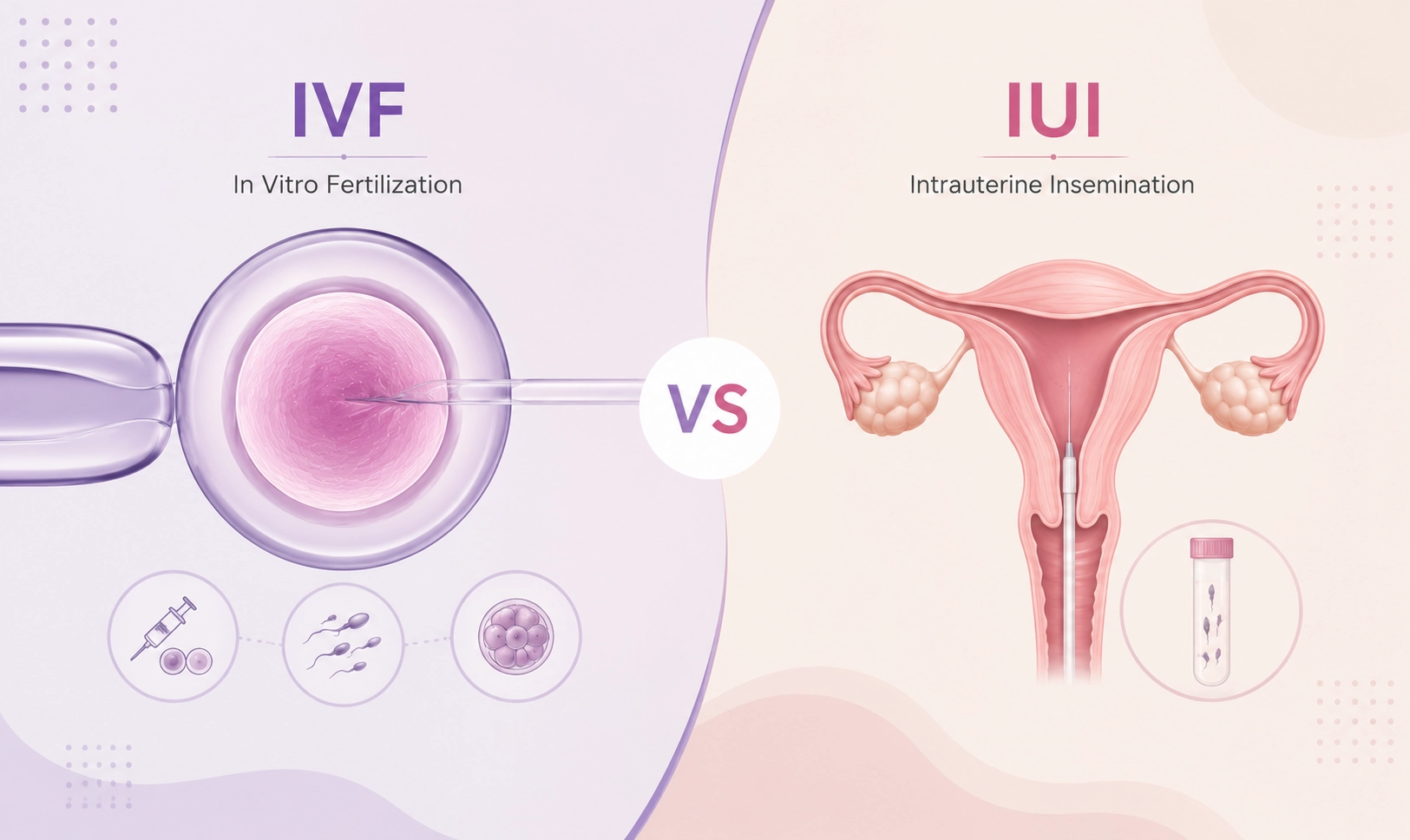
In Vitro Fertilization (IVF) is an advanced fertility treatment. The word in vitro means outside the body. Here, the eggs and sperm are combined in a laboratory to create embryos. One healthy embryo is then transferred into the uterus to achieve pregnancy.
IVF gives the fertility team more control over every step of conception. It is one of the most effective fertility treatments available today.
Common Indications for IVF
A fertility specialist may recommend IVF treatment for:
- Blocked or damaged fallopian tubes
- Severe male factor infertility
- Low ovarian reserve
- Endometriosis-related infertility
- Recurrent IVF or IUI failures
- Advanced maternal age
- Genetic conditions requiring embryo testing
- Long-standing unexplained infertility
Common Concerns About IVF
Many couples worry about the following:
- It is a more involved and emotionally demanding process
- Requires daily hormone injections over 10 to 14 days
- Multiple clinic visits for monitoring
- Higher cost compared to IUI
- Egg retrieval procedure
- Chances of success
Most of these concerns can be addressed through proper counseling, personalized treatment planning, and ongoing support from fertility specialists.
Steps Involved in IVF
- Step 1: Ovarian stimulation with injectable hormones to produce multiple eggs
- Step 2: Monitoring through blood tests and ultrasounds
- Step 3: Egg retrieval under mild sedation (a minor procedure)
- Step 4: Fertilization of eggs with sperm in the laboratory
- Step 5: Embryo culture and development monitoring over 3 to 5 days
- Step 6: Embryo transfer into the uterus
- Step 7: Pregnancy test about 14 days after the transfer
What is IUI?
IUI (Intrauterine Insemination) is a simpler fertility treatment. Sperm that has been washed and prepared in the lab is placed directly into the uterus using a thin, flexible catheter. This is done around the time of ovulation to increase the chances of fertilization.
Common Indications for IUI
IUI treatment may be recommended for:
- Mild male factor infertility (slightly low sperm count or motility)
- Unexplained infertility (where no clear cause is found)
- Ovulatory dysfunction (irregular or absent ovulation)
- Cervical mucus problems that prevent sperm from reaching the egg
- Use of donor sperm
- Early-stage fertility treatment before considering IVF
Common Concerns About IUI
Patients often ask about:
- Whether the procedure is painful
- Chances of success
- Number of cycles required
- Medication side effects
- Whether IUI can replace IVF
- Does it have a lower success rate per cycle compared to IVF
- Will it work if the fallopian tubes are blocked
IUI is generally quick, minimally invasive, and performed as an outpatient procedure.
Steps Involved in IUI
- Step 1: Monitoring of the menstrual cycle (with or without oral medications for ovulation)
- Step 2: A trigger injection is given when the follicle reaches the right size
- Step 3: Semen sample collected and processed in the lab (washing to select the best sperm)
- Step 4: Sperm is inserted directly into the uterus through a thin catheter
- Step 5: Pregnancy test about 14 days later
What Are the Key Differences Between IVF and IUI?
Here is a quick comparison between IVF and IUI, with practical and key pointers to note:
| Aspect | IUI | IVF |
|---|---|---|
| Fertility Laboratory Involvement | Minimal | Extensive laboratory procedures |
| Fertilization Location | Inside the body | Outside the body (in a lab) |
| Anesthesia Required | No | Yes (mild sedation for egg retrieval) |
| Egg Retrieval Required | No | Yes |
| Hormonal Stimulation | Mild oral or injectable medications | Injectable hormones for over 10 to 14 days |
| Embryo Creation | No | Yes |
| Ability to Assess Embryo Quality | Not possible | Possible |
| Genetic Testing Option | Not available | Available in selected cases |
| Suitable for Severe Infertility | Usually not | Yes |
| Number of Monitoring Visits | 2 to 3 visits per cycle | 6 to 10 visits per cycle |
| Control Over Fertilization Process | Limited | High |
| Cycle Duration | 2 to 3 weeks | 4 to 6 weeks (full cycle) |
Who Should Consider IVF?
IVF is often recommended when fertility challenges are more complex or when time is an important factor.
You may be a good candidate for IVF if:
- Both fallopian tubes are blocked
- Sperm count or sperm quality is significantly reduced
- You have severe endometriosis
- You are above 35 years of age, and your fertility potential is declining
- Multiple IUI cycles have failed
- You have diminished ovarian reserve
- Genetic testing of embryos is recommended
For many couples, IVF offers the highest chance of pregnancy per treatment cycle, particularly when underlying fertility issues are significant.
Who Should Consider IUI?
Many couples begin fertility treatment with IUI because it is less invasive and more affordable.
You may be a good candidate for IUI if:
- At least one fallopian tube is open
- You have mild sperm abnormalities
- You have ovulation-related issues that respond to medication
- The cause of infertility remains unexplained
- You are younger and have a shorter duration of infertility
- Donor sperm is being used
When people search for who is a candidate for IUI, the answer often depends on whether fertilization can reasonably occur naturally once sperm is placed closer to the egg.
What is the Success Rate of IVF and IUI Fertility Treatments?
Success rates vary widely. They depend on multiple factors and should never be taken as a guarantee. Here is a general overview:
- IUI Success Rates: Per cycle, IUI has a success rate of roughly 10-20%. Across 3 to 6 cycles, cumulative success can reach 30-50% in suitable candidates.
- IVF Success Rates: IVF has significantly higher per-cycle success rates. In India, IVF success rates typically range from 40-60% per cycle for women under 35. This rate declines with age.
What Do IVF and IUI Success Rates Depend On?
Before signing up for a treatment, every couple searches for IVF success rates and IUI success rates.
However, success depends on many factors and cannot be predicted solely by treatment type. These factors are:
- Age of the woman (younger age = better egg quality and higher success)
- Cause of infertility (certain diagnoses respond better to one treatment over the other)
- Ovarian reserve and egg quality
- Sperm quality and count
- Quality of the fertility clinic and laboratory
- Overall health and BMI
- Lifestyle factors such as smoking, stress, and sleep
- Number of embryos transferred (in IVF)
- Endometrial thickness and receptivity
When Do Fertility Specialists Recommend Moving From IUI to IVF?
This is one of the most common questions couples ask. Your doctor will advise the switch when IUI is unlikely to give you a better outcome than what you have already experienced.
Fertility specialists typically recommend moving to IVF when:
- Three to six IUI cycles have not resulted in pregnancy
- The woman is 35 or older and has limited time to try multiple cycles
- A new finding (such as blocked tubes or worsening semen parameters) rules out IUI
- Ovarian reserve has declined between cycles
- The couple is experiencing significant emotional fatigue from repeated IUI failures
- There is an indication for genetic testing of embryos (PGT)
- The diagnosis changes after further investigation
P.S.: Knowing when to choose IVF can prevent unnecessary delays and improve the chances of achieving pregnancy sooner.
What is the Cost Difference Between IVF and IUI Treatments?
Cost is a real and practical concern for most families in India. Here is a general comparison. Actual costs vary by clinic, city, and individual treatment requirements.
| Cost Component | IUI (Per Cycle) | IVF (Per Cycle) |
|---|---|---|
| Basic Procedure Cost | Rs. 5,000 to Rs. 15,000 | Rs. 1,00,000 to Rs. 2,00,000 |
| Medications | Rs. 2,000 to Rs. 8,000 | Rs. 30,000 to Rs. 80,000 |
| Monitoring Tests | Rs. 1,500 to Rs. 3,000 | Rs. 10,000 to Rs. 20,000 |
| Semen Processing | Included or Rs. 500 to Rs. 1,500 | Included in lab charges |
| Embryo Freezing | Not applicable | Rs. 15,000 to Rs. 30,000 (if needed) |
| Approximate Total | Rs. 8,000 to Rs. 25,000 | Rs. 1,40,000 to Rs. 3,00,000+ |
Note: These are indicative figures for India. Costs at Archish Fertility & IVF Centre in Bengaluru are shared transparently during your consultation. There are no hidden charges.
How Do Doctors Decide Between IVF and IUI Treatment?
A good fertility specialist does not recommend a treatment based on preference or protocol. The decision is based entirely on your medical profile.
Here is how the decision is typically made:
- Fallopian Tube Status: If even one tube is open and functional, IUI may be considered first. If both tubes are blocked or damaged, IVF is the only option.
- Semen Analysis Results: Mildly reduced parameters may be managed with IUI. Severely reduced count or motility points toward IVF with ICSI.
- Women’s Age and Ovarian Reserve: Older women or those with low AMH levels benefit more from the higher success rate of IVF.
- Duration of Infertility: Couples who have been trying for over two years with no prior treatment may be advised to skip IUI and proceed directly to IVF.
- Prior Treatment History: Failed IUI cycles are a direct indication to escalate to IVF.
- Presence of Conditions like Endometriosis or Fibroids: These often require IVF for optimal outcomes.
- Emotional and Financial Readiness of the Couple: A good fertility specialist considers this, too. They will guide you through what is realistic and sustainable for your family.
At Archish Fertility & IVF Centre, every decision is made after a thorough fertility assessment and an open conversation with you. You will never be pushed into a treatment you are not ready for.
Conclusion
Choosing between IUI and IVF can feel confusing, but the decision becomes clearer once the underlying cause of infertility is identified. IUI may be an excellent first step for couples with mild fertility concerns, while IVF is often the preferred option for more complex cases or when higher success rates are needed.
The best approach is a personalized one. A comprehensive fertility evaluation helps determine whether IVF or IUI is likely to provide the best outcome for your unique situation.
Ready to take the next step? Book a fertility consultation at Archish Fertility & IVF Centre, Bengaluru. Our specialists will review your reports, answer all your questions, and help you decide the right fertility treatment.
FAQs
In general, IVF has higher success rates per cycle because fertilization occurs in a controlled laboratory environment and embryo development can be monitored before transfer.
Yes. Depending on your age, fertility diagnosis, ovarian reserve, and sperm quality, your doctor may recommend IVF as the first treatment option.
IUI is generally less expensive than IVF. However, treatment decisions should be based on effectiveness and medical suitability, not cost alone.
Yes. IVF is commonly recommended after repeated unsuccessful IUI cycles and often provides a higher chance of pregnancy in such situations.