Can You Get Pregnant Naturally with PCOS, or Is IVF Needed?
Yes, you can get pregnant naturally with PCOS. Polycystic ovary syndrome (PCOS) can make ovulation less predictable, but it does not automatically mean you are infertile. Many women with PCOS conceive naturally, while others may need fertility treatment to improve their chances of pregnancy.
IVF is not necessary for every woman with PCOS. It is usually considered only when simpler treatment approaches have not been successful or when other fertility factors, such as blocked fallopian tubes, male infertility, or age-related decline in fertility, are also involved.
If you have been diagnosed with PCOS and are searching “Can I get pregnant naturally with PCOS?” or “Will I need IVF?” on Google, Reddit, or Quora, you are not alone.
At Archish Fertility & IVF, our approach begins with understanding what is affecting your fertility before deciding on the right approach. This guide explains how PCOS affects fertility, what can improve your chances of conceiving naturally, when fertility treatment may be needed, and in which situations IVF becomes the most suitable option.
What is PCOS?
Polycystic ovary syndrome (PCOS) is a common hormonal disorder that affects how the ovaries function. According to the World Health Organization (WHO), PCOS affects an estimated 10% to 13% of women of reproductive age globally. In India, studies suggest that nearly 1 in 5 young women are diagnosed with PCOS.
Some of the common symptoms of PCOS include:
- Irregular or missed periods
- Heavy or prolonged bleeding when periods do occur
- Excess hair growth on the face, chest or back (hirsutism)
- Persistent acne or oily skin
- Weight gain, especially around the abdomen
- Thinning hair on the scalp
- Dark, velvety patches of skin around the neck or underarms
- Insulin resistance and anovulation, or irregular ovulation
It is interesting to note that, each women may experience some, none or completely different symptoms. That’s why the fertility treatment varies from person to person.
How Does PCOS Affect Fertility?
For a pregnancy to occur naturally, one mature egg needs to be released from the ovary each month. In women with PCOS, hormonal imbalances can interfere with this process.
Instead of one follicle maturing and releasing an egg, several small follicles may begin to develop but stop growing before ovulation occurs. This can result in irregular ovulation or anovulation, where no egg is released.
Many women with PCOS also have insulin resistance, which can increase androgen levels and further affect normal ovarian function. As a result, menstrual cycles may become irregular, ovulation may occur less often, and the chances of conception can decrease.
Can You Get Pregnant Naturally with PCOS?
Yes, you can get pregnant naturally with PCOS. While PCOS is the most common cause of anovulatory infertility, it does not mean pregnancy is impossible. Your chances to pregnancy depend on factors such as how often you ovulate, your age, your overall reproductive health, and whether there are any other fertility factors involved.
Researchshows that women with PCOS generally have a lower natural conception rate and a longer time to pregnancy than women without PCOS. This study also highlights that improving overall health before conception can make a meaningful difference.
For women who are overweight or obese, even a 5% to 10% reduction in body weight has been associated with improved ovulation and better chances of conception. Regular physical activity and a balanced diet further support these outcomes.
How Can You Improve Your Chances of Getting Pregnant with PCOS?
While there is no single solution for everyone, a few steps can significantly improve your chances of conception. These are:
- Aim for a healthy weight: If you are overweight, even a modest weight loss of 5% to 10% can improve ovulation and increase the chances of conception.
- Stay physically active: Around 150 minutes of moderate exercise each week, along with a balanced diet, can improve insulin resistance and support ovarian function, even without significant weight loss.
- Track your menstrual cycles: Monitoring your periods and ovulation can help identify your fertile window and determine whether ovulation is occurring regularly.
- Manage underlying health conditions: Addressing insulin resistance and other metabolic concerns can support hormonal balance and improve fertility.
- Do not delay medical advice. If your periods are consistently irregular or pregnancy is not happening despite trying, a fertility evaluation can help identify the next steps.
- Prioritize a balanced diet and hydration: Eat nutrient-rich foods, stay well hydrated, and limit highly processed foods. Good nutrition supports hormonal health, metabolic function, and overall fertility.
- Manage stress and get enough sleep: Chronic stress and poor sleep can affect hormonal balance and ovulation. Regular exercise, mindfulness, and 7 to 9 hours of quality sleep can support your reproductive health.
- Check your nutritional health: Low levels of iron, vitamin B12, folic acid, or vitamin D may affect your overall health before pregnancy. Your doctor may recommend blood tests and supplements, based on your individual needs.
Is IVF Required for PCOS, or Are There Other Options First?
Do all women with PCOS need IVF?
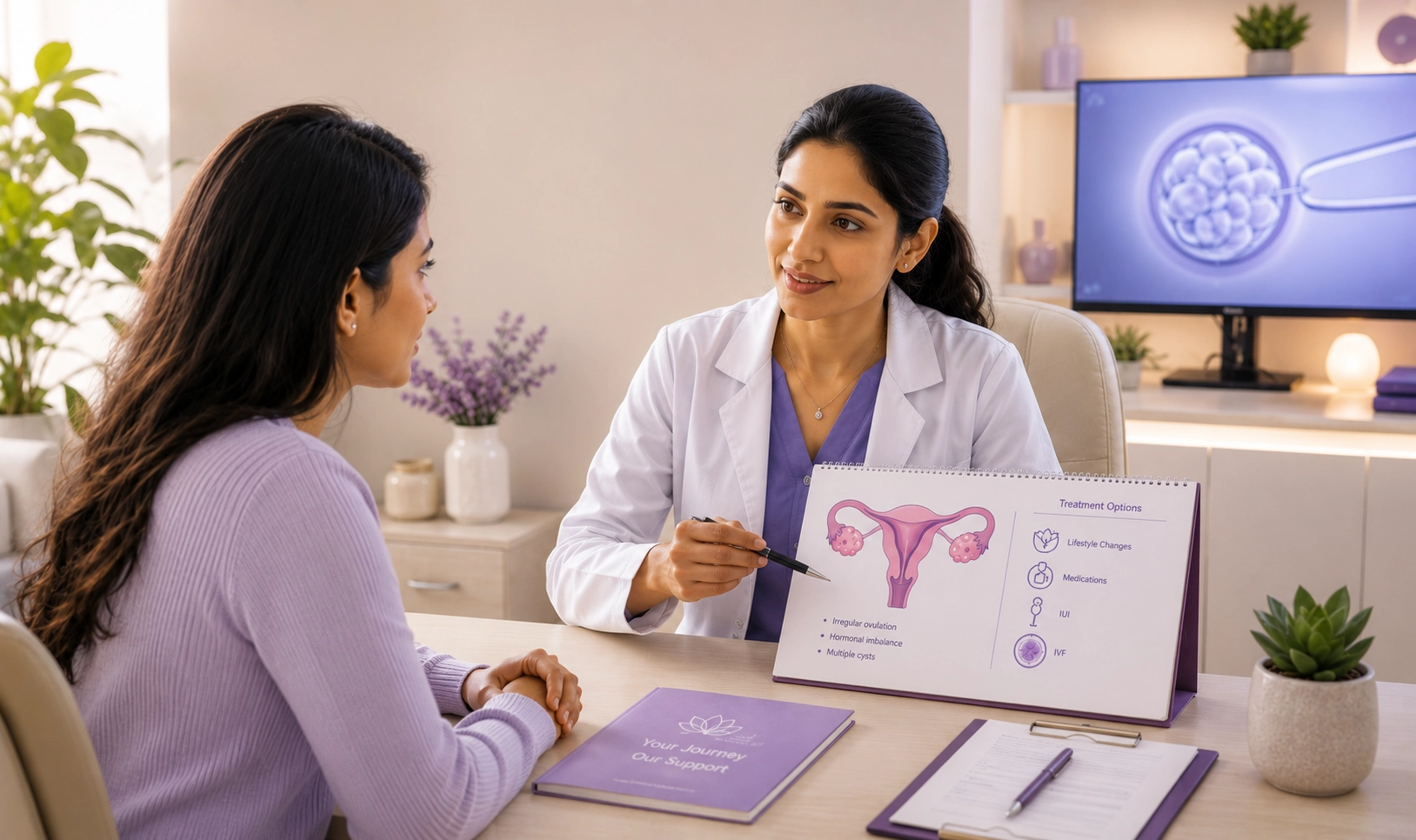
No. IVF is not the first treatment for most women with PCOS. Since the main challenge is often irregular or absent ovulation, treatment usually begins with lifestyle changes and ovulation-inducing medication. If pregnancy does not occur, your fertility specialist may recommend IUI before considering IVF, depending on your age, fertility evaluation, and any other underlying factors.
When is IVF recommended?
IVF may be recommended if:
- Ovulation induction or IUI has not resulted in pregnancy.
- There are additional fertility factors, such as blocked fallopian tubes, endometriosis, or male factor infertility.
- You are over 35 and time is an important consideration.
- Another condition is affecting egg quality or ovarian reserve.
Is IVF Safe for Women with PCOS?
Yes. Women with PCOS may have a higher risk of developing ovarian hyperstimulation syndrome (OHSS) because they often produce more eggs during IVF stimulation.
However, advances in IVF protocols have made treatment much safer.
A 2023 study published in Reproductive Biology and Endocrinology found that women with PCOS tend to respond strongly to ovarian stimulation. It also highlighted that modern IVF approaches, such as GnRH antagonist protocols, GnRH agonist triggers, and frozen embryo transfer, have significantly reduced the risk of OHSS while maintaining good pregnancy outcomes. This allows fertility specialists to tailor IVF treatment safely for women with PCOS.
Natural Conception, Ovulation Induction, IUI or IVF: Which Option is Right for You?
Every fertility journey is different. The right treatment depends on your ovulation pattern, overall reproductive health, age, and any other factors affecting fertility.
Here’s how the options compare:
| Option | When it may be recommended | What it involves |
|---|---|---|
| Natural conception | If you ovulate naturally, even if your cycles are irregular | Lifestyle changes, cycle tracking, and managing underlying PCOS symptoms |
| Ovulation induction | If you have irregular or absent ovulation | Medications such as letrozole to stimulate ovulation, with ultrasound monitoring |
| IUI | If ovulation has been restored but pregnancy has not occurred, or in selected fertility cases | Prepared sperm is placed directly into the uterus around the time of ovulation |
| IVF | If other treatments have not been successful or additional fertility factors are present | Eggs are retrieved, fertilized in a laboratory, and the embryo is transferred to the uterus |
Key Takeaways
- PCOS does not automatically mean infertility. Many women conceive naturally or with simple fertility treatments.
- Lifestyle changes, ovulation induction, IUI, and IVF each have a role, depending on your individual fertility profile.
- IVF is usually considered when other treatment options have not been successful or when additional fertility factors are involved.
- An early fertility evaluation can help identify the right treatment and avoid unnecessary delays.
Not sure whether you should continue trying naturally or explore treatments like ovulation induction, IUI, or IVF?
Connect with the fertility specialists at Archish Fertility & IVF, Bangalore for a comprehensive evaluation. We will help you understand what is affecting your fertility and recommend the treatment approach that offers the best chance of pregnancy for your individual needs.
FAQs
No. Most are offered lifestyle changes and ovulation-inducing medication first. IVF comes in only if these steps do not work, or another fertility factor exists.
Yes. Irregular periods often indicate irregular ovulation, but pregnancy is still possible if ovulation occurs. A fertility evaluation can help determine your chances and whether treatment is needed.
If you are under 35 and have been trying to conceive for a year, or are over 35 and have been trying for six months, it is a good idea to consult a fertility specialist. You should also seek medical advice sooner if your periods are absent or extremely irregular.