ICSI vs IVF: Which Treatment Is Better for Male Infertility?
For male infertility, both IVF and ICSI are effective treatments. However, which one is a better option depends on the sperm quality.
IVF is recommended when sperm count, motility, and morphology are only mildly affected. ICSI is usually preferred in cases of severe male factor infertility because a single sperm is injected directly into the egg.
Many couples do not realize that male factor infertility can also affect the chances of conception. However, several sperm-related fertility challenges can now be addressed with advanced reproductive treatments.
This guide explains the difference between IVF and ICSI, when each treatment is recommended, success rates, and how fertility specialists determine the most suitable approach for achieving pregnancy. At Archish Fertility & IVF Clinic in Bangalore, we provide both IVF and ICSI treatments depending on the requirement.
What Is Male Factor Infertility?
Male factor infertility refers to fertility challenges caused by issues related to sperm production, sperm function, or sperm delivery. It is estimated to contribute to nearly 40-50% of infertility cases among couples trying to conceive.
In many cases, male infertility does not cause obvious symptoms. As a result, it may go undiagnosed until a couple experiences difficulty conceiving.
What are the Common Signs of Male Infertility?
Some men may not notice any symptoms. Hence, the only reliable way to evaluate male infertility is through semen analysis. A semen test checks:
- Sperm count – number of sperm per millilitre of semen
- Sperm motility – how well sperm move
- Sperm morphology – the shape and structure of sperm
- Semen volume and pH
Other signs of male infertility could be:
- Pain, swelling, or discomfort in the testicular area
- A history of testicular injury, surgery, or infection
How is Male Infertility Diagnosed?
A semen analysis helps in diagnosing the following conditions:
- Oligospermia – low sperm count
- Asthenospermia – poor sperm motility
- Teratospermia – abnormal sperm morphology
- Azoospermia – no sperm in the ejaculate (sperm may still be retrieved surgically)
Depending on the findings, a fertility specialist may also recommend hormone tests, genetic testing, or imaging studies. These tests help identify the underlying cause and determine whether IVF, ICSI, or another male infertility treatment may be suitable.
What Is IVF?
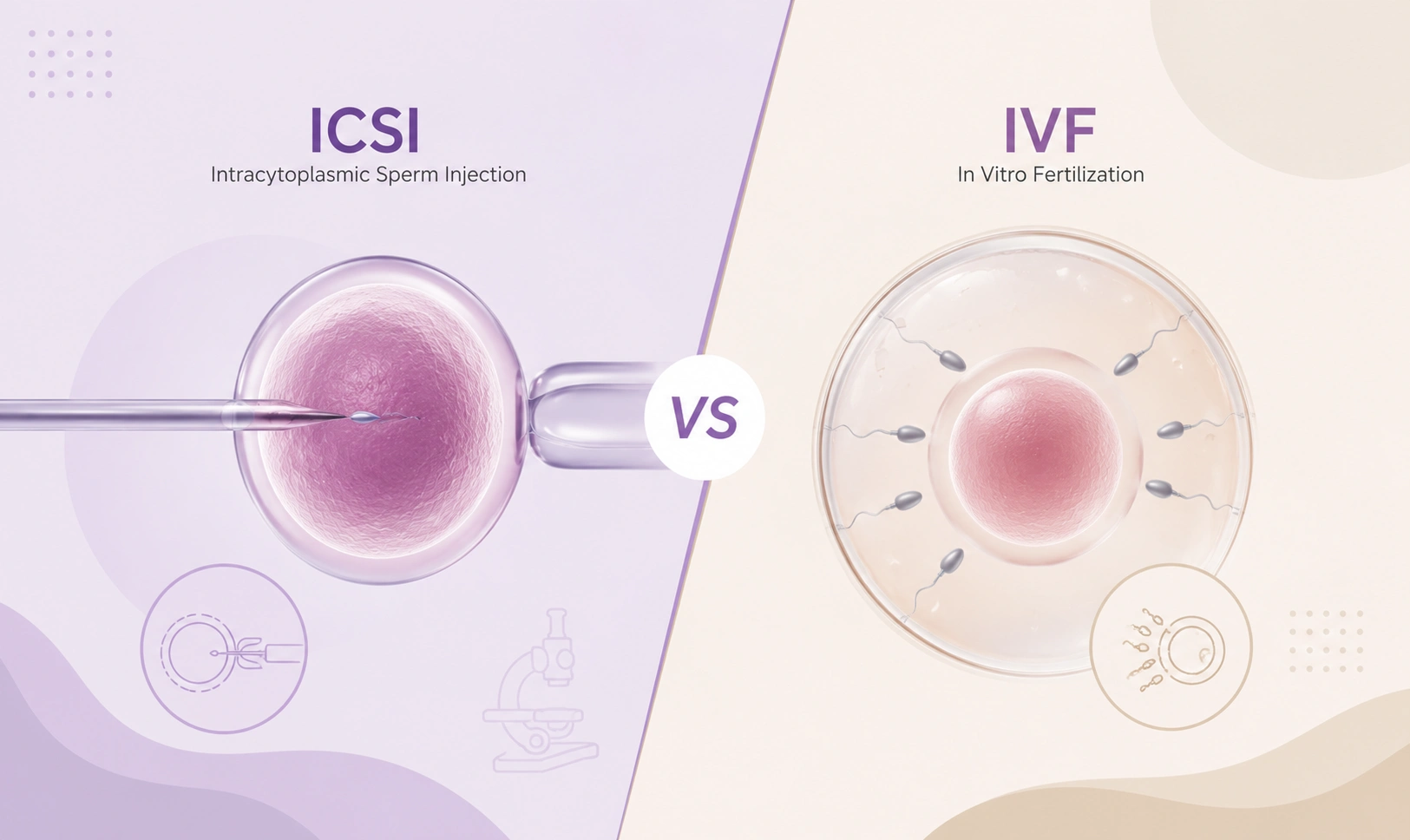
IVF (In Vitro Fertilization) is a fertility treatment in which eggs and sperm are combined in a laboratory to achieve fertilization. Once an embryo develops, it is transferred into the uterus to establish a pregnancy.
During an IVF treatment cycle:
- The ovaries are stimulated to produce multiple eggs.
- Mature eggs are collected from the ovaries.
- The eggs and sperm are placed together in a laboratory dish.
- Fertilization occurs naturally when a sperm enters the egg.
- The resulting embryo is transferred into the uterus.
IVF does not involve directly injecting a sperm into the egg. The sperm must fertilize the egg on its own in the laboratory. For this reason, IVF is generally recommended when sperm quality is normal or only mildly affected.
What is ICSI?
ICSI (Intracytoplasmic Sperm Injection) is an advanced fertility treatment performed as part of an IVF cycle. It involves injecting a single healthy sperm directly into a mature egg to achieve fertilization.
During an ICSI treatment cycle:
- The ovaries are stimulated to produce multiple eggs.
- Mature eggs are collected from the ovaries.
- A sperm sample is collected and prepared in the laboratory.
- An embryologist selects a healthy sperm and injects it directly into a mature egg.
- The fertilized egg is monitored for embryo development.
- The resulting embryo is transferred into the uterus.
ICSI is one of the most commonly performed fertility procedures and is widely used in cases where sperm-related factors may affect fertilization.
What are the Key Differences Between IVF and ICSI?
While both IVF and ICSI are assisted reproductive technologies, the way fertilization occurs is different.
The following table highlights the key differences between IVF and ICSI:
| Factor | IVF | ICSI |
|---|---|---|
| Full Form | In Vitro Fertilization | Intracytoplasmic Sperm Injection |
| Fertilization Method | Eggs and sperm are combined in a laboratory dish for natural fertilization | A single sperm is injected directly into the egg |
| Sperm Requirement | Requires an adequate number of healthy, motile sperm | Can be performed even with very few healthy sperm |
| Laboratory Procedure | Less complex | More specialized and precise |
| Recommended For | Mild male factor infertility and other fertility conditions | Moderate to severe male factor infertility |
| Risk of Fertilization Failure | Higher if sperm quality is significantly affected | Lower in cases of sperm-related fertility challenges |
| Cost | Generally lower | Slightly higher than IVF |
When Is IVF Recommended for Male Infertility?
IVF may be recommended when sperm quality is sufficient for fertilization to occur naturally in the laboratory. It is often considered in cases where male infertility is mild, and the chances of successful fertilization remain favorable.
A fertility specialist may recommend IVF in the following situations:
- Mildly low sperm count
- Mild reduction in sperm motility
- Slight abnormalities in sperm morphology
- Unexplained infertility
- Fertility challenges primarily related to female factors
- Couples with no history of fertilization failure in previous treatment cycles
When Is ICSI Recommended for Male Infertility?
ICSI is often recommended when sperm-related factors may reduce the chances of successful fertilization. By injecting a single sperm directly into the egg, the procedure can help overcome several male fertility challenges.
A fertility specialist may recommend ICSI in the following situations:
- Low sperm count (oligospermia)
- Poor sperm motility
- Abnormal sperm morphology
- Azoospermia, where sperm is retrieved through surgical procedures
- Previous IVF cycles with poor or failed fertilization
- Frozen sperm samples with limited viable sperm
- Cases where sperm quality is significantly affected
IVF, ICSI, or Both? Common Clinical Scenarios Explained
The choice between IVF and ICSI is not always based on sperm quality alone. Fertility specialists also consider factors such as previous treatment outcomes, egg quality, and the couple’s overall fertility profile.
The table below provides a simplified overview of common situations where IVF, ICSI, or both may be considered.
| Clinical Situation | IVF | ICSI | Both May Be Considered |
|---|---|---|---|
| Mild male factor infertility | ✓ | ✓ | |
| Severe male factor infertility | ✓ | ||
| Previous IVF fertilization failure | ✓ | ||
| Unexplained infertility | ✓ | ✓ | |
| Sperm retrieved through surgical procedures | ✓ | ||
| Frozen sperm sample with limited viable sperm | ✓ | ||
| Female age above 35 years | ✓ | ✓ | ✓ |
| Endometriosis-related infertility | ✓ | ✓ | ✓ |
| Blocked fallopian tubes | ✓ | ✓ | ✓ |
| Multiple infertility factors in the couple | ✓ |
Note: Fertility treatments are highly individualized. A treatment that works well for one couple may not be the most suitable option for another, even if the diagnosis appears similar.
Success Rates of IVF and ICSI for Male Infertility
Success rates depend on multiple factors: age of the female partner, egg quality, severity of male infertility, embryo quality, and the clinic’s lab standards.
General benchmarks:
- Fertilization rate with IVF: 65 to 75% per egg when sperm quality is normal
- Fertilization rate with ICSI: 80 to 85% per egg in male infertility cases
- Live birth rate: Comparable between IVF and ICSI when sperm quality is not significantly impaired
A higher fertilization rate does not automatically mean a higher live birth rate. Embryo quality, implantation, and overall clinical factors all play a role.
For severe male factor infertility, ICSI produces a meaningful improvement in fertilization rates. For couples with normal sperm, the live birth rates with both techniques are similar.
What are the Success Rates of IVF and ICSI for Male Infertility?
Success rates depend on multiple factors: age of the female partner, egg quality, severity of male infertility, embryo quality, and the clinic’s lab standards.
General benchmarks are:
- Fertilization rate with IVF: 65 to 75% per egg when sperm quality is normal
- Fertilization rate with ICSI: 80 to 85% per egg in male infertility cases
- Live birth rate: Comparable between IVF and ICSI when sperm quality is not significantly impaired
A higher fertilization rate does not automatically mean a higher live birth rate. Embryo quality, implantation, and overall clinical factors all play a role.
For severe male factor infertility, ICSI produces a significant improvement in fertilization rates. For couples with normal sperm, the live birth rates with both techniques are similar.
IVF or ICSI: What Is Better for Male Infertility?
A randomized controlled trial published in Nature Medicine (2025) studied 824 couples undergoing their first IVF cycle across six fertility clinics in Denmark.
Here is what the research found:
- ICSI did not improve live birth rates compared to conventional IVF in couples without severe male factor infertility
- The cumulative live birth rate was 43.2% in the ICSI group and 47.3% in the conventional IVF group
- In younger women (32 years or under), ICSI was associated with a lower likelihood of live birth compared to conventional IVF
- The study concluded that ICSI should be reserved for severe male infertility cases where conventional fertilization is unlikely to succeed
- Conventional IVF performed as well or better in couples where sperm quality was not severely affected
This means that ICSI is the right choice when there is a clear, clinically confirmed male factor. However, it is not a universal upgrade. A good fertility team will recommend ICSI only when your specific semen analysis and diagnosis warrant it.
At Archish IVF and Fertility Clinic in Bangalore, the embryology team evaluates the actual sperm sample on the day of egg retrieval before making a final recommendation. The goal is always to match the right treatment to each couple’s specific clinical picture.
FAQs
Yes, IVF can work in cases of mildly low sperm count. However, if the sperm count is significantly reduced or sperm quality is severely affected, ICSI may be recommended to improve the chances of fertilization.
ICSI often results in higher fertilization rates in cases of severe male factor infertility. However, higher fertilization rates do not always lead to higher pregnancy or live birth rates. The overall success of either treatment depends on multiple fertility factors.
A typical IVF or ICSI cycle usually takes around 4 to 6 weeks, including ovarian stimulation, egg retrieval, fertilization, embryo development, and embryo transfer.
Not always. Many men with mild sperm-related issues can achieve successful fertilization through IVF. ICSI is typically recommended when sperm quality is significantly affected or when previous IVF cycles have resulted in fertilization failure.